Get Your Business in Front of More Local Customers on Google Maps
A Google Business Profile alone doesn’t guarantee strong visibility in Google Maps. Perino Ranks Local helps strengthen the local signals that improve your relevance, prominence, and opportunities to be discovered by customers searching for your services.
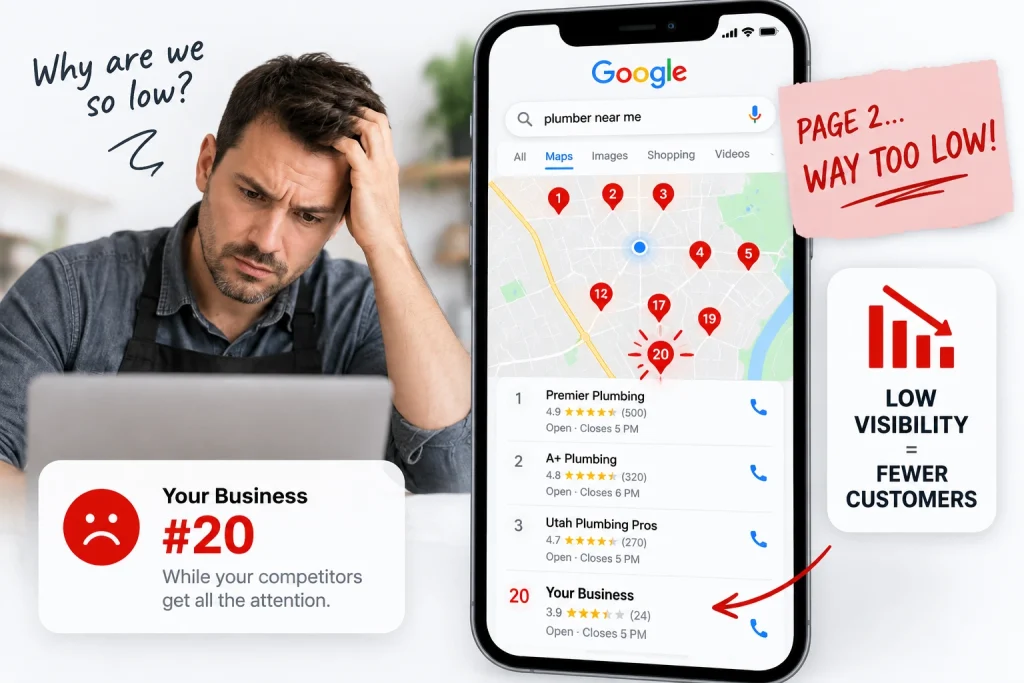
Why Isn't Your Business Showing Higher on Google Maps?
Ranking Is Rarely About One Problem
You can have a great business and still struggle to appear prominently in Google Maps. Why? Because Google doesn’t determine local rankings from your Google Business Profile alone.
Your visibility can be influenced by factors such as:
- Relevance to the search
- Distance from the searcher
- Business prominence
- Google Business Profile signals
- Website relevance
- Reviews
- Local authority
- Business information consistency
- Links and mentions
- Competitive strength
That means adding more keywords to your profile isn’t a complete Google Maps strategy.
The real question is:
Does Google have enough clear, relevant, and trustworthy information to understand why your business should be visible for a particular local search?
What Is Google Maps SEO?
Building the Signals Behind Your Local Visibility
Google Maps SEO is the process of improving the factors that help your business become more relevant and competitive in Google’s local search results. This involves more than optimizing a Google Business Profile.
I look at the relationship between your:
Google Business Profile → Website → Services→ Locations → Reviews
Local Citations → Local Authority → Competitors → Customer Search Intent
When these elements support the same business, services, and market, Google has a clearer picture of what your business is and where it belongs.
I optimize around these relationships rather than chasing isolated ranking tricks.
My Google Maps SEO Approach
I Don't Try to "Hack" the Map Pack
There is no legitimate shortcut that guarantees a #1 Google Maps position. Instead, I focus on understanding why competitors are visible and where your business is currently weaker or underdeveloped.
My approach is built around four questions:
1. Are You Relevant?
Does your business clearly match the services and searches you want to be found for?
2. Are You Close Enough?
Does your business genuinely serve the geographic area represented by the search?
3. Are You Prominent?
Does your business have the reputation, authority, reviews, mentions, and other signals that help establish its prominence?
4. Are Your Signals Consistent?
Does your Google Business Profile, website, citations, reviews, and other online information tell the same story about your business?
What I Optimize
Google Business Profile
Your Google Business Profile is one of the most important assets in your Google Maps presence.
I review and optimize relevant areas such as:
- Primary and secondary categories
- Services
- Business information
- Profile completeness
- Business description
- Photos
- Products where appropriate
- Updates and posts
- Q&A opportunities
- Website connection
- Review strategy
The objective is not to stuff keywords into the profile.
It’s to make the profile accurately represent your business and its services.
Local Relevance
Google needs to understand what your business does and how it relates to the searches people perform.
I strengthen relevant connections between:
Your Business
Your Services
Your Locations
Customer Search Intent
This can involve your Google Business Profile, website content, service pages, location relevance, categories, and supporting local signals.
Competitive Google Maps Analysis
Your competition provides useful information.
I analyze businesses competing for relevant local searches to understand differences in areas such as:
- Google Business Profile optimization
- Categories
- Reviews
- Website strength
- Service coverage
- Local relevance
- Citations
- Local authority
- Content
- Overall search presence
The purpose isn’t to copy competitors.
It’s to identify what Google is seeing in them that may be missing, weaker, or different in your business.
Local Authority & Off-Page Signals
This is where many basic GBP optimization strategies stop. I look beyond the profile itself.
Your business may have supporting signals across:
- Local directories
- Industry websites
- Business associations
- Local organizations
- Relevant websites
- Community resources
- Links and mentions
- Other authoritative sources
The objective is to build a stronger and more consistent representation of your business across the web.
More listings aren’t automatically better. The focus is on relevance, accuracy, quality, and authority.
Website & Google Maps
Reviews can influence how customers evaluate a business after finding it in Google Maps.
I help businesses develop a legitimate review strategy focused on:
- Generating genuine customer feedback
- Monitoring new reviews
- Responding appropriately
- Identifying reputation opportunities
- Maintaining an active and trustworthy profile
I don’t recommend buying reviews, creating fake reviews, or manipulating customer feedback.
Real customer experiences create the strongest foundation for a local reputation.
Competitive Google Maps Analysis
Your website and Google Business Profile should reinforce each other.
Your website should clearly communicate: What you do. Where you do it. Who you serve. Why customers should choose you.
I evaluate whether your important service and location pages support the same local relevance established through your Google Business Profile.
This can include:
- Service page optimization
- Location relevance
- Internal linking
- Local content
- On-page SEO
- Technical SEO
- Structured data
- Business information consistency
Google Maps SEO for Service-Area Businesses
Serving an Area Doesn’t Mean You Need a Fake Address
Service-area businesses often face a unique challenge.
Service-area businesses often face a unique challenge. You may serve multiple cities or communities without having a physical location in every one. The answer isn’t creating fake locations or misleading Google.
Instead, your local search presence should accurately communicate:
Where your business is based
What services you provide
Which areas you genuinely serve
How customers can contact you
I build strategies around real business coverage, not artificial locations.
My Google Maps SEO Process
1. Local Search Discovery
I identify your important services, target markets, customer search behavior, and current Google Maps visibility.
2. Google Business Profile Analysis
I review the profile for optimization opportunities, relevance, completeness, competitive weaknesses, and potential issues.
3. Competitor & Ranking Analysis
I examine relevant competitors to understand which local, industry, and niche sources may be important within your market.
4. Local Signal Analysis
I evaluate your website, citations, reviews, local authority, business information, and other relevant supporting signals.
5. Strategy & Prioritization
I determine which improvements deserve attention first.
Not every possible SEO task needs to be completed.
The priority is the work most relevant to your market and business goals.
6. Implementation
I implement the agreed improvements across the Google Business Profile, website, local presence, content, citations, and other relevant areas.
7. Ranking & Performance Monitoring
I monitor local search performance and customer actions where reliable data is available.
8. Continuous Optimization
Google Maps is competitive and constantly changing.
I use ranking data, competitor movement, and campaign performance to identify the next opportunities.
What Makes My Google Maps SEO Different?
I Don't Treat GBP Optimization as the Whole Strategy
Optimizing a profile is important.
But Google Maps visibility doesn’t exist inside your profile alone.
I look at the broader ecosystem supporting your business.
I Use Competitive Data Before Making Recommendations
Instead of assuming what your business needs, I look at the businesses already competing for the searches you want.
That helps reveal where your biggest gaps and opportunities actually are.
I Don't Chase Citation Volume
Building 500 irrelevant listings doesn’t automatically make a business more prominent.
I focus on relevant sources, accurate information, industry connections, local authority, and the overall consistency of your business entity.
I Focus on Sustainable Local Visibility
I don’t rely on fake locations, fake reviews, keyword-stuffed business names, or other tactics that can put your business at risk.
The objective is to build a local search presence that accurately represents the real business.
What Can Google Maps SEO Help With?
The Goal Is More Than a Higher Pin
Improved Google Maps visibility can create more opportunities for customers to:
Discover your business
View your services
Visit your website
Call your business
Request directions
Compare your business with competitors
Contact you for a quote
Rankings are an important measurement.
But the bigger goal is turning local search visibility into real customer opportunities.
Frequently Asked Questions
What is Google Maps SEO?
Google Maps SEO is the process of improving a business’s presence and competitiveness in Google’s local search results, including Google Maps and the Local Pack.
It can involve Google Business Profile optimization, website relevance, reviews, local authority, citations, competitive analysis, and other local search signals.
How does Google rank businesses on Google Maps?
Google says local results are primarily based on relevance, distance, and prominence.
Relevance considers how well a business matches the search. Distance considers how close the business is to the search location. Prominence relates to how well-known or established a business is based on information Google has about it.
No single optimization guarantees a particular ranking.
Does optimizing my Google Business Profile guarantee better rankings?
No.
Google Business Profile optimization can improve the completeness and relevance of your profile, but Maps rankings depend on multiple factors including relevance, distance, prominence, competition, and other local signals.
How long does Google Maps SEO take?
There is no universal timeline.
The starting condition of the profile, competitiveness of the market, business location, website, reviews, authority, and other local signals can all affect how quickly visibility changes.
Do more reviews guarantee higher Google Maps rankings?
No.
Reviews are one part of the broader local search picture. Review quality, quantity, recency, and the overall reputation of a business can matter, but simply obtaining more reviews does not guarantee a specific ranking.
Can you guarantee a #1 Google Maps ranking?
No.
Anyone promising a guaranteed #1 Maps position is making a claim they cannot reliably control.
I focus on improving the factors within the scope of the campaign and measuring progress using actual search and business data.
Do you work with service-area businesses?
Yes.
I work with strategies designed around businesses that serve customers in defined geographic areas, while keeping their online presence accurate and compliant with Google’s guidelines.
Do citations help Google Maps rankings?
Relevant and accurate citations can support a business’s broader local presence and help establish consistent business information.
Can Google Maps SEO generate more calls?
It can create more opportunities for calls by improving visibility when potential customers search for relevant local services.
However, ranking does not guarantee calls. Your reviews, offer, competition, pricing, reputation, and customer experience also influence whether someone contacts the business.
Let’s Find Out Why
Your Competitors Are Already Showing Up
If your competitors are appearing in Google Maps while your business is difficult to find, guessing at the solution can waste months.
Let’s look at your current visibility, your competitors, and the local signals supporting your business.